
Skip to content
Home / News / From Drone Snap to Architectural Plate: A Professional Retouching Case Study

From Drone Snap to Architectural Plate: A Professional Retouching Case Study

How do you turn drone photography into professional architectural assets

Converting a raw drone “snap” into a brand-standard architectural plate requires a structured workflow focused on vertical perspective correction, exposure blending (HDR), and advanced color grading. By correcting lens distortion and balancing high-contrast lighting, photographers can ensure aerial shots meet the rigorous standards of hospitality and commercial real estate marketing.

As the founder of Picsera, I lead a team that processes thousands of property images every month. However, I believe that to lead a high-level production house, one must remain a practitioner. Recently, I took my Mavic 4 Pro into the field for a personal challenge: taking a complex, mixed-use structure and using a rigorous post-production workflow to meet global hospitality brand standards.

I chose a local podium-style building as my subject. While I wasn’t hired to shoot this specific property, the challenges it presented—vertical distortion, industrial lighting, and environmental clutter—provided the perfect “proving ground” for our architectural workflow.

The Mission: Solving the “Drone Look”

Drones are incredible tools, but they inherently produce images that hospitality brand auditors (like those at Marriott or Hilton) often reject. Why? Because wide-angle drone lenses distort geometry, and raw aerial captures often feel “industrial” rather than “aspirational.”

My goal was to document the three-stage evolution from a raw flight file to a professional-grade architectural asset.

While post-production is where the magic happens, the quality of the final plate is heavily dependent on the raw data captured in the field. For instance, our latest case study on the Mavic 4 Pro explores how high-resolution sensors minimize the noise we have to clean up during the retouching phase.

Stage 1: Exposure Blending & Retouching (The Clean Plate)

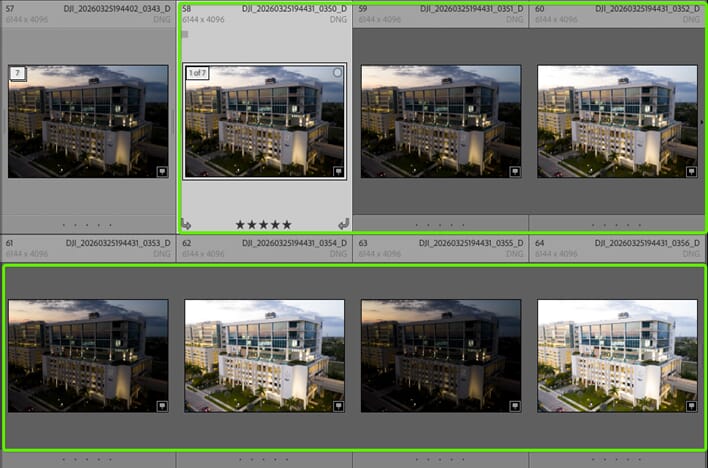
Architectural photography is about managing the relationship between ambient light and artificial light. Using bracketed RAW exposures captured during Blue Hour, the first step of our workflow was Exposure Blending. We manually merged the warm interior glows with the cool twilight of the sky.

Simultaneously, we began the Retouching phase. This is where we create a “pristine reality.” We digitally removed “visual noise”—construction debris, traffic cones, and distracting vehicles—to ensure the eye focuses solely on the architecture.

A grid view of seven bracketed RAW exposures of an architectural drone shot captured with a Mavic 4 Pro. The thumbnails show varying exposure levels from dark to light, intended for manual exposure blending to achieve maximum dynamic range in the final hospitality hero shot.

Stage 2: Comparison — The “Before & After” of Light Management

The second stage of image evolution demonstrates the power of light manipulation. In this phase, we neutralized the distracting yellow “industrial” lights of the parking garage pedestal and enhanced the cyan and magenta hues of the twilight sky.

This “Before and After” highlights the core of the Picsera philosophy: we don’t just edit photos; we curate the visual hierarchy. However, as clean as the image was at this stage, it still suffered from the “drone lean.”

Comparison — The "Before & After" of Light Management

Stage 3: The Final Master — Geometry & Strategic Crop

The final evolution is the “make or break” moment for architectural assets: Vertical Correction. In professional architecture, vertical lines must be 90° to the horizon. If they aren’t, the building loses its structural prestige.

We used Manual Guided Uprights to lock every column into a perfect vertical orientation, mimicking the look of a $10,000 tilt-shift lens. Finally, we applied a Strategic Crop and used Luminance Range Masking to dim the parking garage interior. This forced the viewer’s eye to stay on the high-end hotel levels and the glowing pool deck.

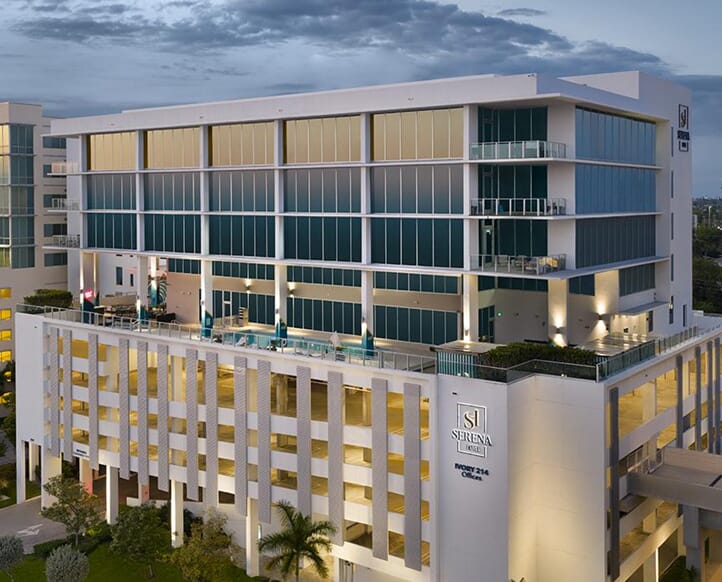
The Final Result: A technically flawless architectural hero shot. Note the perfect geometry, the neutralized utility lighting, and the balanced visual flow.

Final architectural hero shot showcasing a professional post-production workflow. The image demonstrates high-end retouching on a modern multi-use building, including vertical integrity, removal of environmental clutter, and luminance range masking to shift focus to the illuminated hotel signage and rooftop pool deck.

A Global Production Partner for Architectural Excellence

This study proves that a world-class image is built, not just taken. My journey as a practitioner-founder ensures that Picsera stays at the cutting edge of what is possible in architectural post-production.

We are a full-service production house with a diverse, global network of elite architectural photographers. Whether you are a developer requiring a full-scale production from the ground (or air) up, or a photographer seeking a partner to help your work pass brand-standard audits, we provide the end-to-end expertise you need.

Let’s master your next architectural project together.