How do you add human scale and clean up clutter in ground architectural photography?
Resolving ground-level challenges in architectural photography requires strategic post-production, primarily focusing on color-deconstruction and non-disruptive human compositing. De-saturating distracting pavement elements (like high-contrast yellow safety lines) shifts the visual weight back to the building’s raw textures. Furthermore, compositing scale figures facing away from the lens adds life and context without disrupting the spatial design or drawing attention away from the architecture.
Once I packed up my drone gear, the shoot was only half over. Walking up to the Braman Cancer Center with my ground rig meant completely shifting my mindset. Up in the air, it’s all about grand geometry and massing, but down on the pavement, it gets incredibly intimate.
This facility is such an important lifeline for South Florida families and patients traveling all the way from South America for world-class care, so I really wanted my ground shots to feel welcoming, human, and true to CannonDesign’s vision. Transitioning from the flight patterns detailed in my Mavic 4 Pro Case Study to a tripod on the sidewalk forced me to approach the building from an entirely new perspective.
Here are the two main challenges I focused on solving once my boots hit the ground.
Theme 1: Taming Ground-Level Chaos
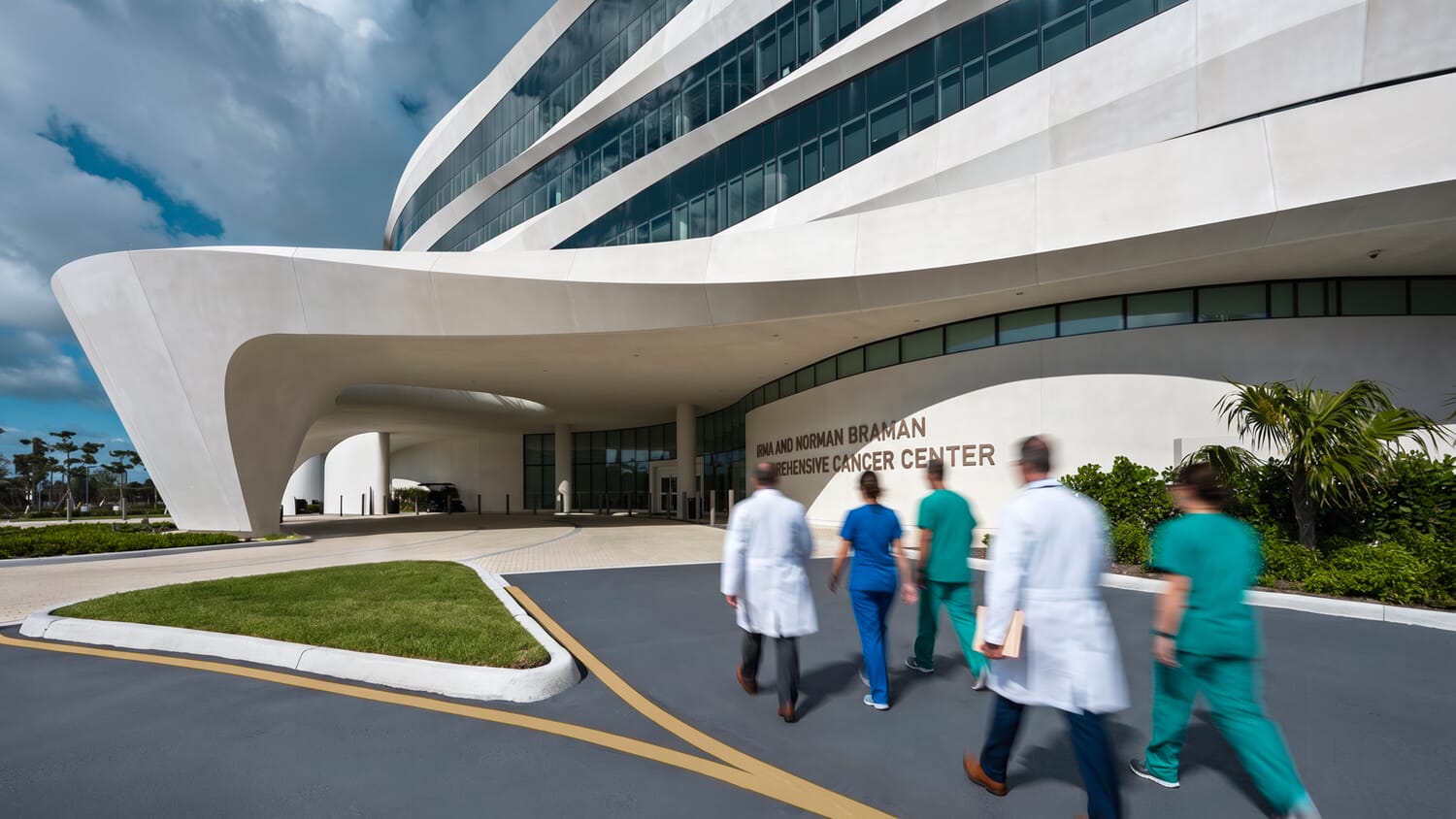
When I’m shooting from the sidewalk, I’m immediately forced to look at real-world clutter that I can easily fly right over with a drone. For me, the biggest issue on the ground is always the pavement. There’s nothing that ruins a luxury architectural look faster than bright, high-contrast yellow parking lines competing with pristine precast concrete.
I didn’t want the asphalt to dominate the bottom of my frames or pull attention away from that incredible entrance canopy. Instead of trying to crop the ground out entirely, I fixed it in post-production by desaturating those safety yellow lines by about 60%. Turning them into a quiet, muted gray completely balanced the visual weight of the image, letting the true textures of the building finally do the talking.

Theme 2: Solving the Human Scale Problem in Post
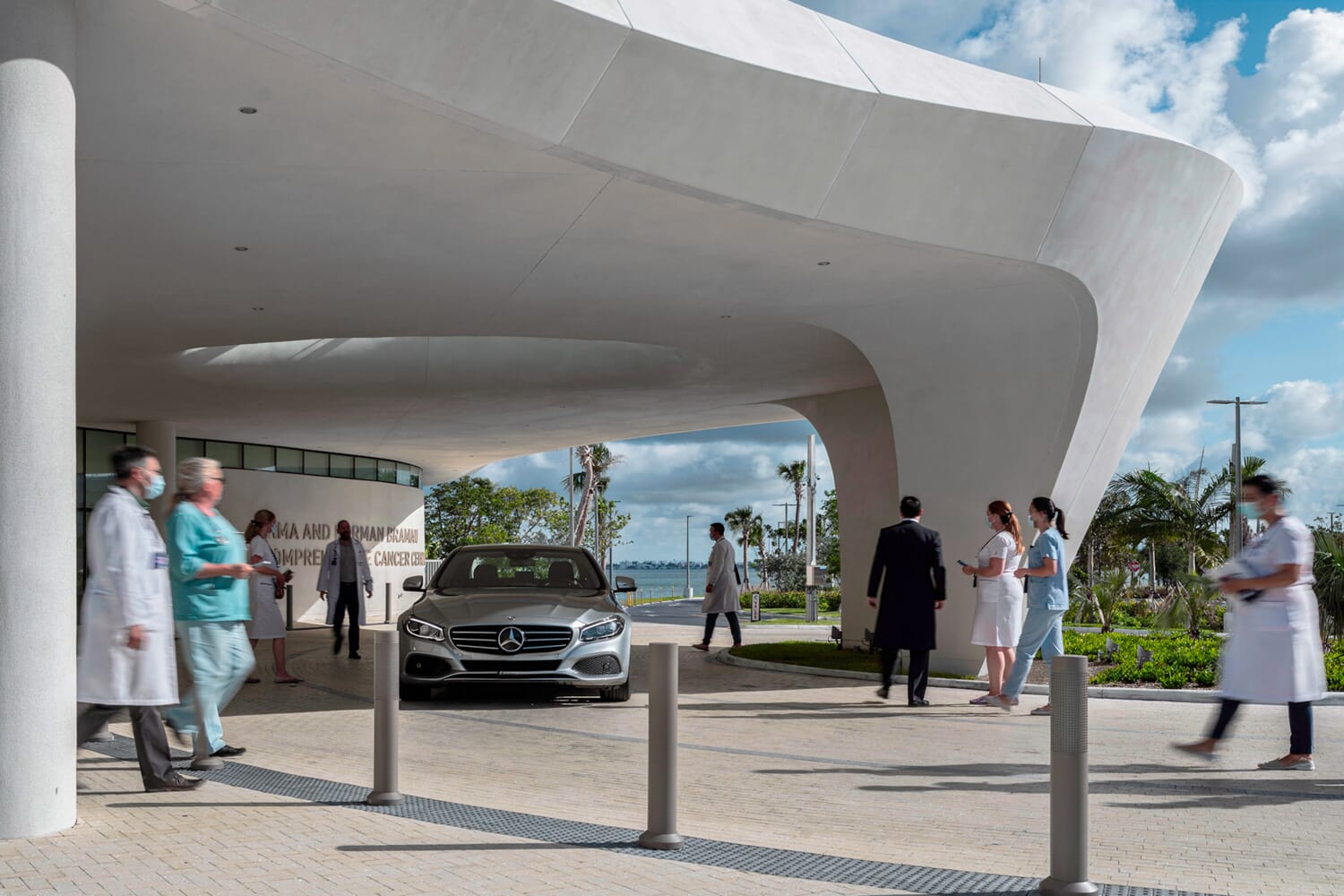
For a major medical facility like this, adding people into the frame is essential. It brings a sense of warmth, purpose, and scale to a place built entirely for healing. But the day I was out there shooting, the site was completely empty. I didn’t have any models on set to work with, so I had to get creative and solve the problem later in post-production.
When I composite people into an architectural shot after the fact, I follow one strict rule: never let them look at the camera. The moment a person stares at the lens, it stops being a study of space and becomes a casual snapshot of an individual.
I chose figures facing away or caught mid-stride, blending them in seamlessly to show how patients and visitors would naturally navigate the circulation loops and pathways. This methodology mirrors the clean, intentional asset-creation workflows we mapped out in our Professional Retouching Case Study, proving that whether the asset originates from the air or the pavement, consistency is key. It adds that vital sense of life and movement without ever distracting from the design its
Wrapping It Up
Moving from the air to the ground really reminded me that architectural photography is a constant mix of patience and problem-solving. Whether it’s flattening out telephoto lines from a mile away over the bay or meticulously compositing human scale into an empty courtyard in post-production, the goal never changes. It’s all about stripping away the real-world noise so the architect’s true design can shine.